
Do I really need a Shopify?
Great question, and one that I get a lot.
Maybe you’re starting things off in Etsy or you launched on Squarespace. There’s really no wrong starting point when you’re launching an ecommerce business–or any business for that matter.
BUT each platform has a specific purpose. If you’re a service-based business usually closing deals in DMs or on sales calls you won’t want to launch a site on Shopify.
If you’re a jewelry brand with 100 products that each have 3 variants per SKU, you’ll defffffffinitely want to consider making the jump to Shopify.
Here’s why–
1. Shopify is made to sell
That might be obvious but that goes way beyond just being able to actually sell things. Shopify has tons of systems and tools designed specifically to make selling easier.
For starters, Shopify has a familiar, streamlined checkout experience that customers already know how to use. And when it comes to actually getting those orders out the door, Shopify has built-in tools to help manage everything from order processing to fulfillment.
It also has automatic notification emails for pretty much every part of the customer journey: sale, pre-order, item shipped, item en route, item delivered, order refunded, order cancelled, account created–seriously, I could go on forever.
And that's just the beginning. From discounts and gift cards to abandoned checkout recovery and customer accounts, Shopify gives you a whole ecosystem of tools to help turn browsers into buyers and keep customers coming back.
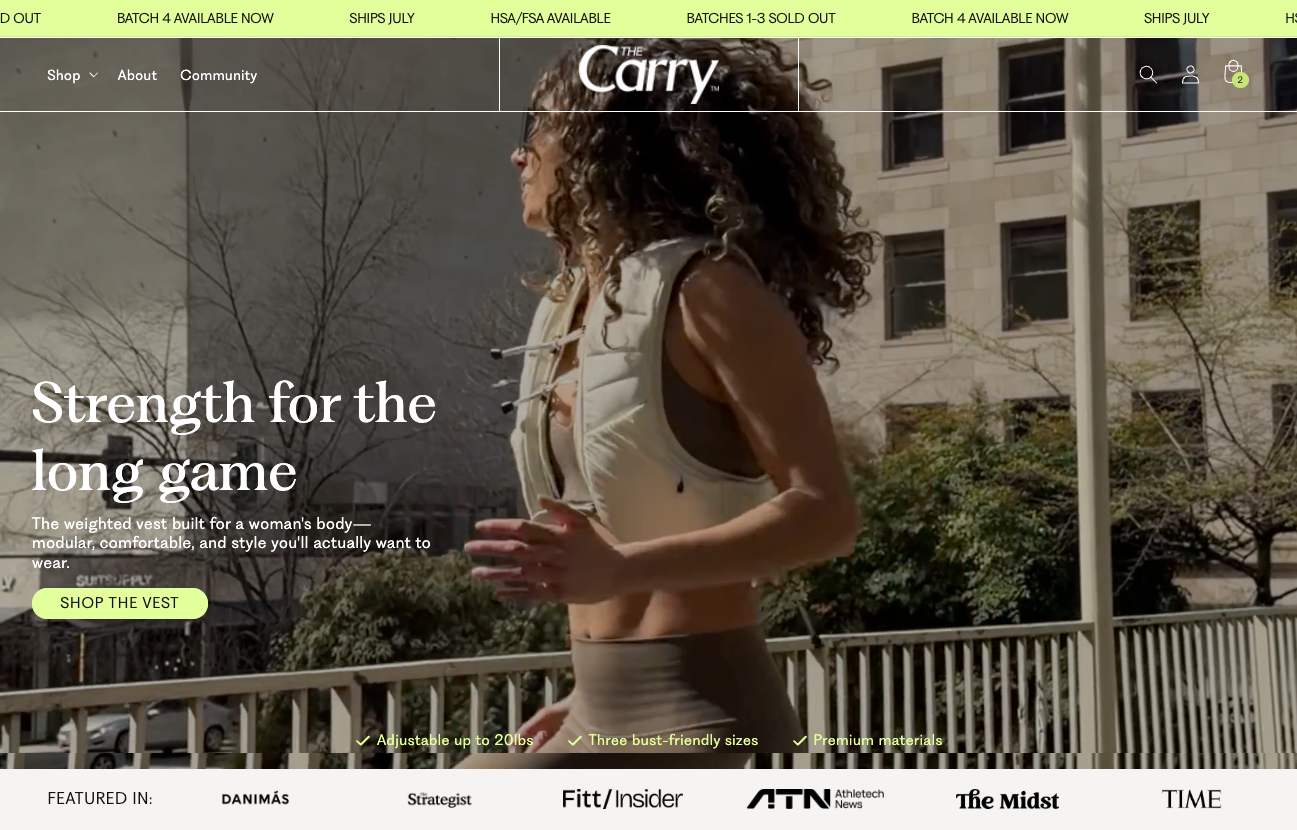
The Carry is a brand dedicated to improving women’s longterm health and wellness with weighted vests. When founders Cortney and Esther first came to me they were frustrated with the set-up of their shop:
“We were ready to make some meaningful updates to not only up-level our brand's vibe and aesthetic, but make it more shoppable in an effort to increase conversions.”

Together we curated an on-brand site that matched the energy of their brand and marketing. But more importantly, we customized every single customer touch point from CTAs to checkout experience to post-purchase and retention.
Within their first 3 months post re-launch, they saw over +$50K increase in revenue, a 13 point increase in conversions, and average order value increase 8x.
2. It has incredible analytics tools and easy integrations that are made specifically for ecommerce brands.
Ok fine, lots of platforms offer integrations and 3rd-party tools. However, Shopify makes the connection even easier with a dedicated apps portal and even a collection of Shopify-produced apps to help make your site do what you need it to do without needing ANOTHER tool to connect it to your site (goodbyeeeeee Zapier!)
And when it comes to understanding how your shop is actually performing, Shopify has built-in analytics and reporting tools that let you track everything from sales and conversion rates to customer behavior and product performance. Because knowing how many people are visiting your website is one thing. Knowing where they're coming from, what they're buying and where they're dropping off? That's where things get juicy.
3. Lots of Shopify themes are primed with tons of tools to streamline the shopping experience
Most platforms come completely empty or worse, with AI tools that put together what could have been a good idea but falls short of your actual vision for your site. Shopify, however, works with themes, a collection of premade sections and pages that make up the front-facing site.
The process is: create an account > choose a theme > customize theme + upload products > launch.
Shopify itself has hundreds of incredible free and premium themes (our favorite free theme is Dawn, and favorite premium theme is Broadcast) that come pre-made with tons of incredible functionality and sections.
Think product recommendations, promotional banners, product filters, quick add-to-cart buttons and customizable product pages. All of these tools can help make shopping easier for your customers. And the best part? You can customize these themes to fit your brand, your products and the way you want customers to shop.
To answer your question, no, you don't technically need a designer or developer to launch an awesome site on Shopify.
BUT, working with a designer and developer can help you bring your exact vision to life, create a shopping experience that actually makes sense for your customers and make sure all the systems are set up to support your business as it grows.
Last year I worked with lifestyle and yoga brand Srimanta, who uses Shopify to sell physical products and digital services, as well as book in-person courses and workshops.
He needed a booking system that could clearly differentiate between online and in-person classes, locations, and languages, while also connecting attendees to pre- and post-class resources, WhatsApp groups, and custom communications.
We trialed a series of apps and systems, but none could showcase all of the information we needed. So we built him a fully custom option that ticked all the boxes.
We uploaded courses as products with variants for dates and locations, then connected everything directly to his email CMS with customized segmentation and email templates.
This not only improved the user experience and sign-ups for workshops, it significantly streamlined Srimanta’s own system for offering, booking, and communicating with attendees.
This is one of the reasons I love Shopify: when an off-the-shelf solution doesn't quite fit, we can build around the way your business actually works.

Finally, the most important question: Do I need a Shopify?
Let’s keep this really simple. Answer these 4 questions and tally up your ‘yes’ and ‘no’ responses:
Is the primary purpose of your business to sell products?
Do you have multiple products/variants you’re selling?
Will you be using a fulfillment system to manage and ship orders?
Do you want to easily track the analytics and performance of your shop?
If you answered yes to any of these, especially if it was for 3 or more of these, then I’d highly recommend exploring Shopify as an option.
Of course, it also depends on your budget, business model and what you actually need your website to do. If you're just starting out with a handful of products, Etsy might be all you need for now. If you're primarily selling services, Squarespace or another website platform might be a better fit.
The goal isn't to have the biggest, fanciest website. It's to have a website that actually works for your business.
Okay, so you've decided to use Shopify. Now what?
You've (maybe) decided to use Shopify for your business. It's time to get everything set up to actually do what it needs to do: sell. We've got tons of free resources to help you do exactly that right here on the blog.
We've also got a free Shopify checklist that takes you through everything from choosing a theme to the moment you launch.